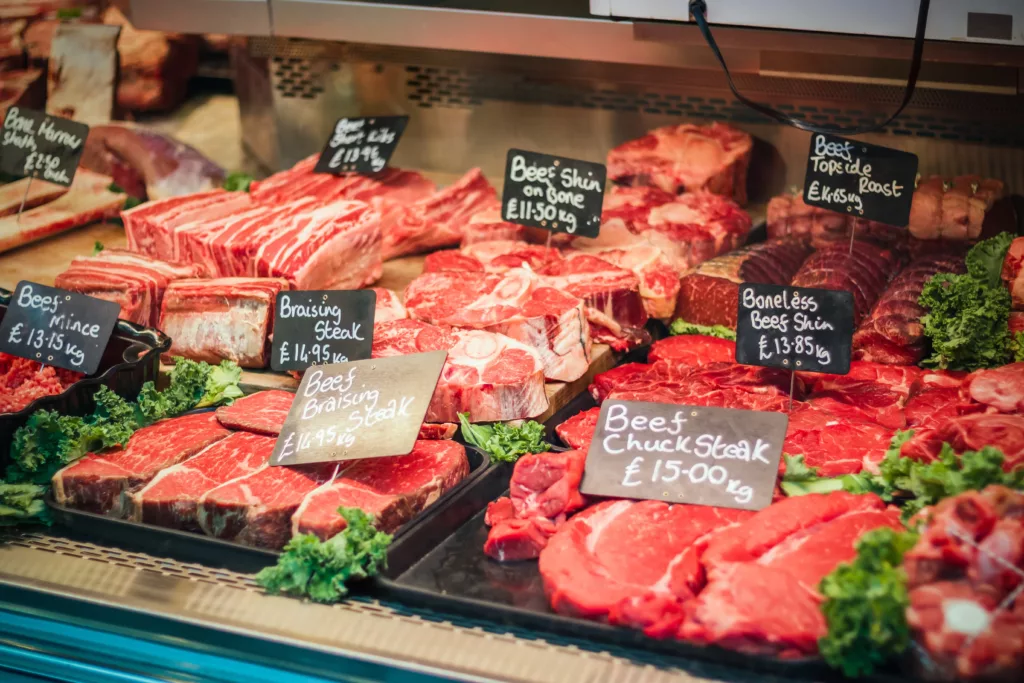
Member Information: Pricing Legislation Change
Member Information: Pricing Legislation Change
From April this year, amendments were made to pricing legislation which affected how some prices had to be displayed. The general requirements and rules for displaying prices remain in place:
- a selling price
- a unit price for many foods sold ‘loose from bulk’ (typically, the unwrapped counter meat weighed and sold at customer request)
- a unit price for many foods sold prepacked in variable quantities. This is where food of the same type has been completely wrapped up but the declared weight varies.
- that, in larger shops (over 280sqm), a unit price is shown for many foods sold prepacked in fixed quantities. This is where food of the same type has been completely wrapped up but the declared weight is always the same.
- imperial unit prices (per lb/oz) only are not permitted.
- these prices are clearly shown.
Previously, some foods were required to be unit priced ‘per 100g’ rather than ‘per kg’. For butchers, this was predominantly for cooked meats, including game and poultry.
Now, the cooked meat must show a price ‘per kg’, rather than ‘per 100g’.
There may be concern that the meat could appear more expensive to customers used to seeing it priced per 100g, we recommend ensuring you carry out training with your teams to communicate with customers. For those who wish to imperial prices can be used but only as an additional indication, not instead of it. Where imperial prices are added, the metric prices must be predominated and be in characters of equal or larger size.
Transparency is the aim behind the legislation, customers should not have to ask the price of a product, the prices should be indicated clearly. Consider the following:
- Is the price readable from the necessary distance?
- Is the label printing properly? They can have faint areas or the ink jets become blocked.
- Are the size of the font and its colour and background effective? If not, this may also fail the statutory food information requirements, if the same labeller or notice is used.
- Is it clear which price applies to which item? Have regard to those with particular needs, such as the elderly or those with disabilities.
Other areas to consider are, businesses which operate a membership-style scheme, where different prices are charged to members and non-members. Here, both sets of prices must be displayed, together with the appropriate condition (e.g. ‘with loyalty card’).
Also, promotional pricing. Whether all prices will need to be changed or a general notice is sufficient depends on several factors, including practicality of changing the prices, is it a wide product range covered, and is it a short promotion period.
If you would like advice on managing changes to legislation in your business, then call 01892 541 412 to speak to our technical advice line.*
*Please note this article is intended for guidance. It does not form part of NCB’s and ESCC Assured Advice.